Water Activity in Green Coffee

MAINTAINING GREEN COFFEE QUALITY THROUGH WATER ACTIVITY CONTROL

The international coffee market is valued at $102 billion. It includes everything from freeze dried instant coffee to specialty blends carefully sourced from specific growing locations. Coffee beans are harvested as a coffee cherry that is then processed to remove the fleshy cherry covering to produce green coffee beans. These green coffee beans are the form in which the coffee is stored and transported. When it is time to produce coffee, the green beans are roasted to create the familiar roasted coffee beans that are purchased at a store or utilized at a coffee house. The roasted beans are ground and brewed to produce the familiar cup of coffee. Obviously, each of these steps provide their own challenges and each can impact the quality of the coffee produced.

Coffee quality is tracked throughout processing from harvest to coffee production. Initially, quality of green beans and roasted beans is done visually based on size and appearance, which is followed by the most important quality measurement of the coffee produced, a process called cupping. This cupping process looks at flavor, aftertaste, acidity, body, and uniformity among others and gives a score between 1-100 with specialty coffees expected to score 80 or higher.Ā  Unfortunately, finding that a sourced coffee bean does not cup well may be too late as the beans have already been purchased. It would be preferrable to be able to conduct tests on the green beans themselves at the time of harvest to predict the cupping quality. Water activity has been investigated as a potential measurement on green coffee beans to predict the cupping quality of sourced coffee beans.

Water Activity in Green Coffee

THEORY OF WATER ACTIVITY IN GREEN COFFEE

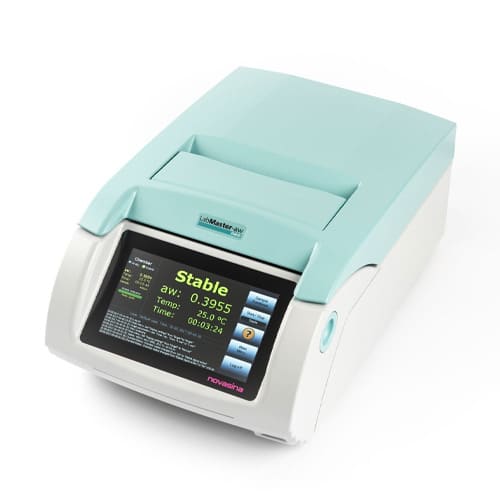
Water activity is defined as the energy status of water in a system. For green coffee, water activity is measured by equilibrating the liquid phase water in the sample with the vapor phase water in the headspace of a closed chamber and measuring the Equilibrium Relative Humidity (ERH) in the headspace using a sensor. The relative humidity can be determined using a resistive electrolytic sensor, a chilled mirror sensor, or a capacitive hygroscopic polymer sensor. Instruments from Novasina, like the Labmaster NEO, utilize an electrolytic sensor to determine the ERH inside a sealed chamber containing the sample. Changes in ERH are tracked by changes in the electrical resistance of the electrolyte sensor. The advantage of this approach is that it is very stable and resistant to inaccurate readings due to contamination, a particular weakness of the chilled mirror sensor. The resistive electrolytic sensor can achieve the highest level of accuracy and precision with no maintenance and infrequent calibration. Coffee beans can be tested whole or crushed with crushing providing advantages in testing time and repeatability.

Water Activity in Green Coffee

WATER ACTIVITY AND CUPPING QUALITY IN GREEN COFFEE

The value of tracking water activity of green coffee beans is not directly in a correlation to cupping score. In other words, 2 coffee beans at the same water activity will not necessarily have the same cup score, nor will the cup score increase by a predictable amount as water activity either increases or decreases. Consequently, some studies have concluded that water activity is not useful enough to justify testing and that relying on moisture content should be sufficient. The problem with this conclusion is first, moisture content analyses are in almost all cases more difficult and much less reliable than water activity testing. Secondly, the value of water activity is not in a direct correlation to cupping score, but in providing an optimal range for storage to avoid microbial contamination, slow degradative chemical reactions, and maintain metabolic activity. The recommended optimal water activity range for stored green coffee beans is 0.45-0.55 aw. Drying and storing green coffee beans at this water activity range will not improve the cupping quality of the green coffee beans, but instead will maintain the quality for 6-8 months.

WATER ACTIVITY IN GREEN COFFEE AND MICROBIAL GROWTH

The main reason for using 0.55 aw as the upper limit for stored green coffee beans is to prevent microbial growth. Each microorganism has an ideal water activity inside their membrane and their ability to reproduce and grow depends on maintaining that water activity. Each microorganism has a unique limiting water activity below which they cannot grow.
These growth limits indicate that all pathogenic bacteria stop growing at water activities less than 0.87 while the growth of common spoilage yeasts and molds stops at 0.70 aw, which is known as the practical limit. Only xerophilic and osmophylic organisms can grow below 0.70 aw and all microbial growth stops at water activities less than 0.60. Molds and their accompanying mycotoxins would be the most likely contaminants on green coffee beans and their presence can result in musty off flavors and odors or worse, a reaction to the mycotoxins. However, at water activities less than 0.55, green coffee beans would not support the growth of any microorganisms, thereby justifying the ideal range being below 0.55 aw.

WATER ACTIVITY IN GREEN COFFEE AND CHEMICAL STABILITY

An additional reason to for maintaining green coffee beans at water activities less than 0.55 is to limit the rates of potentially harmful chemical reactions. In general, as water activity increases so do reaction rates, but lipid oxidation is unique in that the reaction rate also increases at very low water activity. Examples of reactions that can result in the degradation and end of shelf life of green coffee beans are Maillard browning (changes in color and flavor), lipid oxidation (rancidity) and staling.
Keeping the water activity of green coffee beans below 0.55 aw will slow the rate of these reactions, but they will still occur. The time required for the reaction to have progressed to the point of unacceptability at a given water activity and temperature will be the product’s shelf life. If the rate constants for these reactions at several different storage conditions are determined, a predictive model can be used to estimate the time needed for the reaction to proceed to an unacceptable level under any storage conditions.

WATER ACTIVITY IN GREEN COFFEE AND METABOLIC STABILITY

The main reason for not allowing the water activity of stored green beans to drop below 0.45 aw is to maintain the viability of the green seeds including the enzymatic activity that is critical to maintaining the expected flavor and aroma profile for a coffee. Green coffee beans at water activities less than 0.45 aw will potentially lose their viability, resulting in aged flavors when the coffee is roasted. In addition, at water activities less than 0.45, the surface of green coffee beans can potentially become more rigid and brittle, resulting in poor grinding performance in preparation for roasting.

Water Activity in Green Coffee

IDEAL WATER ACTIVITY FOR GREEN COFFEE

Like most products, green coffee is sold on a weight basis, so maximizing the amount of water, the cheapest ingredient, that can be in a product while remaining safe and stable will maximize profitability. The ideal water activity range for storing green coffee beans has been identified and moving above or below this range will render the product undesirable. A green coffee with a cupping quality of 88 stored outside the ideal water activity range can experience multiple point drops in cupping score in just 1-2 months. The key then to maximizing profitability while ensuring quality is to make sure that the water activity of green coffee beans is in the 0.45-0.55 aw range.

" Water activity testing of green coffee beans is important to maintain quality. To maximize your profits and make sure that the standard of your products remain the same water activity measurement should be included in your production process."
Dr. Brady Carter world-renowned specialist in water activity

Download the full Application note here!
Water Activity in Green Coffee

Water activity meters best suited for Green Coffee
LabSwift-aw
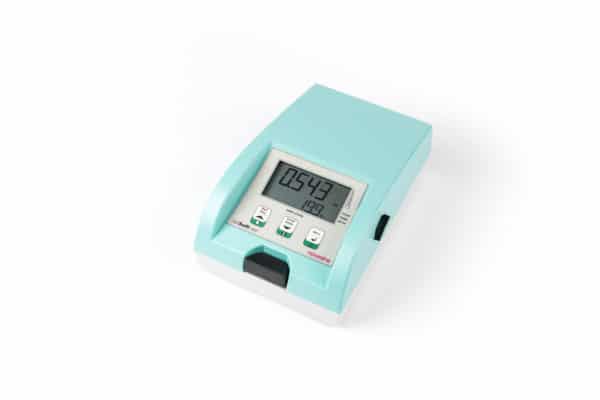
One measurement in the lab, then again on the line, the LabSwift-aw with rechargeable battery offers this possibility. The device is designed for daily use and for samples in the low to medium aw range.

LabTouch-aw

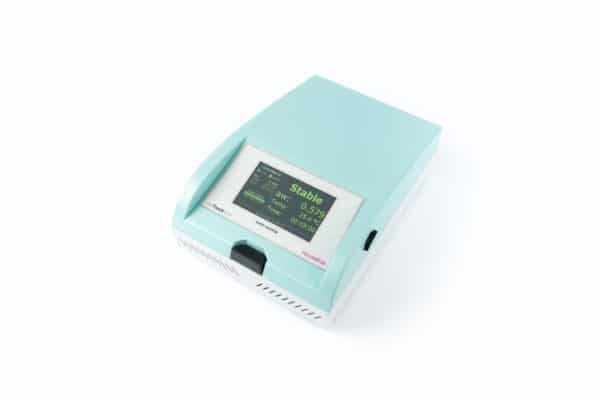
Flexible and fast water activity meter with large touch screen. Easy to use, very well suited for AT-Line measurements in production or for the exact determination of AW-values in the QC-Lab.

LabMaster-aw neo

Top water activity measuring device with technological lead, perfect for the daily routine determination of water activity in QA laboratories of food and pharmaceutical companies. This measuring instrument also provides support in the investigation of the causes of product spoilage, texture changes or rancidity.
Novasina AG

Talk to an Expert

Chat

Chat with us

Send us a Message

Write us via our form

Arrange a callback

    Who we are?

    This website and its content is provided by a company with commercial interests.

    The responsible body in terms of data protection laws, in particular the EU General Data Protection Regulation (GDPR), is:

    Novasina AG
    Neuheimstrasse 12
    CH-8853 Lachen
    Telefon +41 55 642 67 67
    Telefax +41 55 642 67 70
    E-MailĀ info@novasina.ch
    InternetĀ http://www.novasina.com

    What personal data we collect and why we collect it

    When you access this website, information of a general nature is automatically collected. This information is collected in the server log file and includes the type of web browser, the operating system used, the domain name of your Internet service provider, your IP address and the like.

    This is for the following reason:

    • Ensuring a problem-free connection setup of the website.
    • To ensure a smooth use of our website
    • To evaluate system security and stability, and
      for other administrative purposes

    Your data will not be used to draw conclusions about your person. Information of this kind is only evaluated statistically in order to optimize our website and the technology behind it.

    Storage duration

    The data is deleted as soon as it is no longer required for the purpose for which it was collected. This is generally the case for the data used to provide the website when the respective session has ended.

    When you post a comment, it is saved indefinitely, including metadata. This way, we can automatically detect and approve follow-up comments instead of holding them in a moderation queue.
    For users who register on our site, we also store the personal information they provide in their user profiles. All users can view, change, or delete their personal information at any time (the username cannot be changed). Administrators of the website can also view and modify this information.

    Comments

    When visitors post comments on the website, we collect the data displayed in the comment form, in addition to the visitor’s IP address and the user agent string (this identifies the browser) to help detect spam.

    Media

    If you are a registered user and upload photos to this website, you should avoid uploading photos with an EXIF GPS location. Visitors to this website might download photos stored on this website and extract their location information.

    Contact forms

    The data you enter will be stored for the purpose of individual communication with you. For this purpose, it is necessary to provide a valid e-mail address and your name. This serves the assignment of the request and the subsequent response to the same. The specification of further data is optional.

    Cookies

    When you write a comment on our website, this can be a consent to store your name, email address and website in cookies. This is a convenience feature so that when you write another comment, you do not have to enter all this data again. These cookies are stored for one year.

    If you have an account and you log in to this website, we will set a temporary cookie to determine if your browser accepts cookies. This cookie does not contain any personally identifiable information and is discarded when you close your browser.

    When you log in, we will set some cookies to store your login information and viewing options. Login cookies expire after two days and display options cookies expire after one year. If you select “Stay logged in” when you sign up, your login will be maintained for two weeks. When you log out of your account, the login cookies are deleted.

    Use of script libraries (Google Webfonts)

    In order to display our content correctly and graphically appealing across browsers, we use “Google Web Fonts” from Google LLC (1600 Amphitheatre Parkway, Mountain View, CA 94043, USA; hereinafter “Google”) on this website to display fonts.

    The privacy policy of the library operator Google can be found here: https://www.google.com/policies/privacy/

    Embedded content from other websites

    Posts on this website may contain embedded content (e.g. videos, images, articles, etc.). Embedded content from other websites behaves exactly as if the visitor had visited the other website.

    These websites may collect information about you, use cookies, embed additional third-party tracking services, and record your interaction with this embedded content, including your interaction with the embedded content if you have an account and are logged into this website.

    Use of Google Analytics

    This website uses Google Analytics, a web analytics service provided by Google LLC, 1600 Amphitheatre Parkway, Mountain View, CA 94043 USA (hereinafter: “Google”). Google Analytics uses “cookies”, which are text files placed on your computer, to help the website analyze how users use the site. The information generated by the cookie about your use of this website is usually transmitted to a Google server in the USA and stored there. However, due to the activation of IP anonymization on these web pages, your IP address will be truncated beforehand by Google within member states of the European Union or in other contracting states of the Agreement on the European Economic Area. Only in exceptional cases will the full IP address be transmitted to a Google server in the USA and shortened there. On behalf of the operator of this website, Google will use this information for the purpose of evaluating your use of the website, compiling reports on website activity and providing other services relating to website activity and internet usage to the website operator. The IP address transmitted by your browser as part of Google Analytics will not be merged with other data from Google.

    The purposes of data processing are to evaluate the use of the website and to compile reports on website activities. Based on the use of the website and the internet, other related services shall then be provided.

    Use of Google Maps

    On this website we use the offer of Google Maps. Google Maps is operated by Google LLC, 1600 Amphitheatre Parkway, Mountain View, CA 94043, USA (hereinafter “Google”). This allows us to display interactive maps directly on the website and enables you to use the map function conveniently.

    You can find more information about data processing by Google in the Google privacy policy. There you can also change your personal data protection settings in the data protection center.

    What rights you have to your data

    If you have an account on this website or have posted comments, you may request an export of your personal data from us, including any data you have provided to us. In addition, you can request the deletion of all personal data that we have stored about you. This does not include data that we are required to retain for administrative, legal or security needs.

    Where we send your data

    Visitor comments could be examined by an automated service for spam detection.

    Contact information

    For data protection-related concerns, please contact the person(s) named in the imprint.

    How we protect your data

    SSL encryption

    To protect the security of your data during transmission, we use state-of-the-art encryption methods (e.g. SSL) via HTTPS

    Questions for the data protection officer

    If you have any questions about data protection, please write us an e-mail or contact directly the responsible person in our organization listed for data protection at the beginning of the privacy policy.