

The measurement and monitoring of relative humidity make it possible to control and regulate humidification through installed fogging systems. They come into action when the humidity is too low. If the humidity is too high, ventilation or heating systems can help.
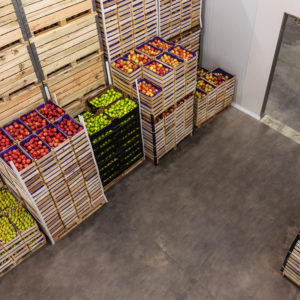
Losses of commercial crops due to improper storage and handling can range from 10 – 40%. Proper storage conditions – temperature and humidity – are needed to increase storage life and maintain quality once the crop has been cooled to the optimum storage temperature. Fresh fruits and vegetables need low temperatures => 0.5 – 12°C and high relative humidity => 90 – 98 % to lower respiration and to slow metabolic and transpiration rates. By slowing these processes, water loss is reduced and food value, quality and energy reserves are maintained.
The most popular air humidity measurement principle used is the capacitive technology. This measuring principle essentially consists of a special polymer which can absorb and release moisture to match the room humidity and in the process experiences changes to its electrical capacitance.
This and similar measuring principles such as the psychrometric principle (with 2 temperature probes) react rather sluggishly to changes in the measured value or even remain at high humidity levels for a long time until the sensor releases the water stored in the polymer again and can determine the real measured value, which means that changes in high humidity levels during the monitoring process are detected very slowly or not at all.
The consequences are high hysteresis, inaccuracy, limited sensor lifetime and sudden sensor failures. This can dramatically increase cost of operation (excessive use of water), maintenance (frequent recalibration) and service/repair (sensor replacement).
The more reliable the humidity and moisture measurement for your storage procedure is, the more accurate the climatic environment can be regulated. Since temperature and relative humidity are among the factors that prolong storage life and nutritional quality. Reliable measurements save energy and enable constant quality control of the product.
The sensor should react quickly and linearly to changes in climate, even at humidity levels of well over 90% RH and be unaffected by low temperatures around the freezing point. A high level of accuracy with a measurement uncertainty of less than 1.5% is required to enable a grower to maintain optimum conditions for maximum storage life of the crop. It will also help to minimize crop damage from chilling, freezing, heating and water loss from the crop. Close attention to storage conditions will yield returns through greater customer satisfaction, less waste and spoilage and the flexibility to hold a crop without significant storage losses to wait for better prices.
Regular checking and maintenance of the sensors is therefore essential. For this reason, Novasina also offers various options for checking the installed sensors yourself regularly and without great effort or by specialized personnel.
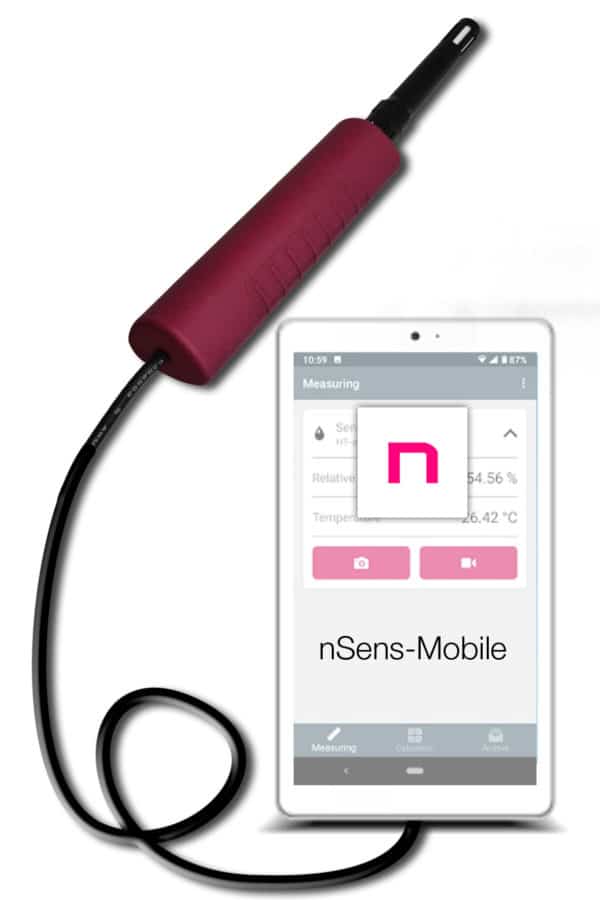
The most important factors to consider when choosing an RH/Temp sensor for crop storage facilities are the response time, possible external influences, accuracy and maintenance intensity. Novasina’s RH/Temp sensors meet all these requirements while still being affordable. Find out more about our climate measurement devices below.
Our trained dealers can be found around the globe and will be happy to support you with your concerns.
Novasina AG, © 2021
| Cookie | Duration | Description |
|---|---|---|
| cookielawinfo-checkbox-analytics | 11 months | This cookie is set by GDPR Cookie Consent plugin. The cookie is used to store the user consent for the cookies in the category "Analytics". |
| cookielawinfo-checkbox-functional | 11 months | The cookie is set by GDPR cookie consent to record the user consent for the cookies in the category "Functional". |
| cookielawinfo-checkbox-necessary | 11 months | This cookie is set by GDPR Cookie Consent plugin. The cookies is used to store the user consent for the cookies in the category "Necessary". |
| cookielawinfo-checkbox-others | 11 months | This cookie is set by GDPR Cookie Consent plugin. The cookie is used to store the user consent for the cookies in the category "Other. |
| cookielawinfo-checkbox-performance | 11 months | This cookie is set by GDPR Cookie Consent plugin. The cookie is used to store the user consent for the cookies in the category "Performance". |
| viewed_cookie_policy | 11 months | The cookie is set by the GDPR Cookie Consent plugin and is used to store whether or not user has consented to the use of cookies. It does not store any personal data. |
This website and its content is provided by a company with commercial interests.
The responsible body in terms of data protection laws, in particular the EU General Data Protection Regulation (GDPR), is:
Novasina AG
Neuheimstrasse 12
CH-8853 Lachen
Telefon +41 55 642 67 67
Telefax +41 55 642 67 70
E-Mail info@novasina.ch
Internet http://www.novasina.com
When you access this website, information of a general nature is automatically collected. This information is collected in the server log file and includes the type of web browser, the operating system used, the domain name of your Internet service provider, your IP address and the like.
This is for the following reason:
Your data will not be used to draw conclusions about your person. Information of this kind is only evaluated statistically in order to optimize our website and the technology behind it.
The data is deleted as soon as it is no longer required for the purpose for which it was collected. This is generally the case for the data used to provide the website when the respective session has ended.
When you post a comment, it is saved indefinitely, including metadata. This way, we can automatically detect and approve follow-up comments instead of holding them in a moderation queue.
For users who register on our site, we also store the personal information they provide in their user profiles. All users can view, change, or delete their personal information at any time (the username cannot be changed). Administrators of the website can also view and modify this information.
When visitors post comments on the website, we collect the data displayed in the comment form, in addition to the visitor’s IP address and the user agent string (this identifies the browser) to help detect spam.
If you are a registered user and upload photos to this website, you should avoid uploading photos with an EXIF GPS location. Visitors to this website might download photos stored on this website and extract their location information.
The data you enter will be stored for the purpose of individual communication with you. For this purpose, it is necessary to provide a valid e-mail address and your name. This serves the assignment of the request and the subsequent response to the same. The specification of further data is optional.
When you write a comment on our website, this can be a consent to store your name, email address and website in cookies. This is a convenience feature so that when you write another comment, you do not have to enter all this data again. These cookies are stored for one year.
If you have an account and you log in to this website, we will set a temporary cookie to determine if your browser accepts cookies. This cookie does not contain any personally identifiable information and is discarded when you close your browser.
When you log in, we will set some cookies to store your login information and viewing options. Login cookies expire after two days and display options cookies expire after one year. If you select “Stay logged in” when you sign up, your login will be maintained for two weeks. When you log out of your account, the login cookies are deleted.
In order to display our content correctly and graphically appealing across browsers, we use “Google Web Fonts” from Google LLC (1600 Amphitheatre Parkway, Mountain View, CA 94043, USA; hereinafter “Google”) on this website to display fonts.
The privacy policy of the library operator Google can be found here: https://www.google.com/policies/privacy/
Posts on this website may contain embedded content (e.g. videos, images, articles, etc.). Embedded content from other websites behaves exactly as if the visitor had visited the other website.
These websites may collect information about you, use cookies, embed additional third-party tracking services, and record your interaction with this embedded content, including your interaction with the embedded content if you have an account and are logged into this website.
This website uses Google Analytics, a web analytics service provided by Google LLC, 1600 Amphitheatre Parkway, Mountain View, CA 94043 USA (hereinafter: “Google”). Google Analytics uses “cookies”, which are text files placed on your computer, to help the website analyze how users use the site. The information generated by the cookie about your use of this website is usually transmitted to a Google server in the USA and stored there. However, due to the activation of IP anonymization on these web pages, your IP address will be truncated beforehand by Google within member states of the European Union or in other contracting states of the Agreement on the European Economic Area. Only in exceptional cases will the full IP address be transmitted to a Google server in the USA and shortened there. On behalf of the operator of this website, Google will use this information for the purpose of evaluating your use of the website, compiling reports on website activity and providing other services relating to website activity and internet usage to the website operator. The IP address transmitted by your browser as part of Google Analytics will not be merged with other data from Google.
The purposes of data processing are to evaluate the use of the website and to compile reports on website activities. Based on the use of the website and the internet, other related services shall then be provided.
On this website we use the offer of Google Maps. Google Maps is operated by Google LLC, 1600 Amphitheatre Parkway, Mountain View, CA 94043, USA (hereinafter “Google”). This allows us to display interactive maps directly on the website and enables you to use the map function conveniently.
You can find more information about data processing by Google in the Google privacy policy. There you can also change your personal data protection settings in the data protection center.
If you have an account on this website or have posted comments, you may request an export of your personal data from us, including any data you have provided to us. In addition, you can request the deletion of all personal data that we have stored about you. This does not include data that we are required to retain for administrative, legal or security needs.
Visitor comments could be examined by an automated service for spam detection.
For data protection-related concerns, please contact the person(s) named in the imprint.
SSL encryption
To protect the security of your data during transmission, we use state-of-the-art encryption methods (e.g. SSL) via HTTPS
If you have any questions about data protection, please write us an e-mail or contact directly the responsible person in our organization listed for data protection at the beginning of the privacy policy.


 Neuheimstrasse 12